
Home oxygen therapy for COPD is indicated when resting arterial oxygen saturation (SpO₂) falls to 88% or below, or when PaO₂ drops to 55 mmHg or less on two separate measurements taken three weeks apart. Prescribed in stable patients who meet these thresholds, it reduces pulmonary hypertension, improves sleep quality, and extends survival when used for at least 15 hours daily. Patients with higher resting SpO₂ but documented nocturnal desaturation or exercise-induced hypoxia may also qualify the threshold shifts based on clinical context.
According to Dr. Manu Madan, a leading pulmonologist in Noida, “Most patients wait far too long because mild breathlessness gets normalised by the time oxygen is formally considered, pulmonary hypertension is already silently progressing.”
Experiencing worsening breathlessness or low oxygen readings at home?
Who Qualifies for Long-Term Oxygen Therapy in COPD?
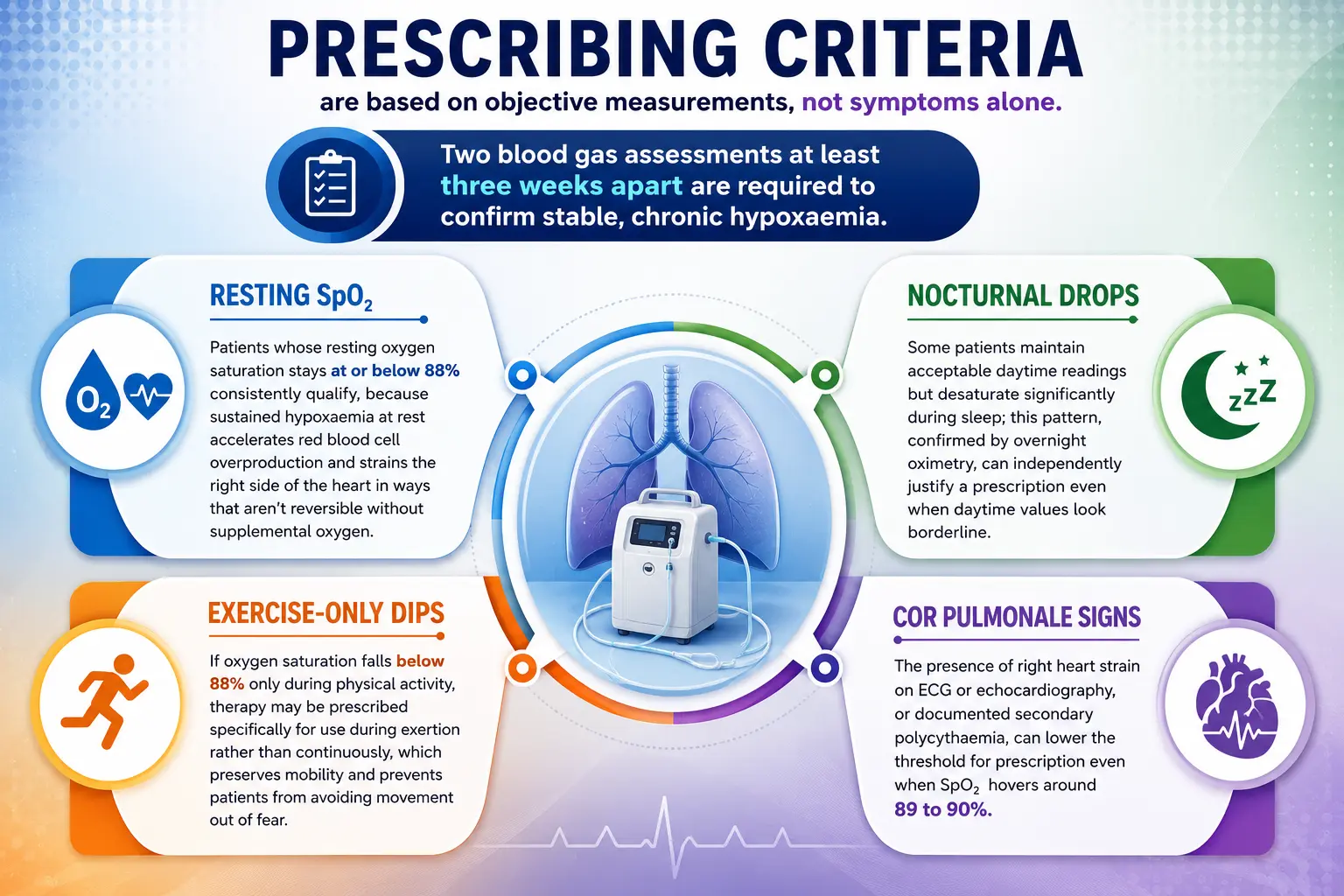
Meeting one of these criteria isn’t automatically enough the prescribing pulmonologist considers the full clinical picture, including smoking status, since prescribing oxygen to active smokers carries serious fire risk, as outlined in this overview of COPD Treatment.
What Happens If Oxygen Therapy Is Started Too Late or Too Early?
Timing matters clinically. Both premature prescription and delayed initiation carry measurable consequences, and neither decision should rest on patient preference alone.
- Too early: The LOTT trial found no survival benefit in patients with SpO₂ 89–93%. Early prescription without clear criteria may also reduce physical activity by tethering patients to equipment.
- Too late: Untreated hypoxaemia accelerates right heart failure, worsens pulmonary hypertension, and impairs cognition, effects that don’t fully reverse once oxygen is started.
- Device choice: Concentrators over cylinders for home use. Flow rate and delivery method should match the patient’s daily pattern, not set once and forgotten.
- Reassessment: Re-evaluate at 90 days post-exacerbation patients who initially meet criteria may no longer need long-term therapy once inflammation resolves.
- The goal is functional improvement, better sleep, reduced breathlessness, and slower progression, especially for patients already exposed to Delhi-NCR air pollution and COPD flare-ups.
Why Choose Dr. Manu Madan?
Dr. Manu Madan holds an MBBS from Maulana Azad Medical College, an MD in Pulmonary Medicine from Vallabhbhai Patel Chest Institute, and a DM in Pulmonary, Critical Care, and Sleep Medicine from AIIMS, New Delhi. Senior Consultant and Lead of Respiratory and Sleep Medicine at Medanta Hospital, Noida, he has over 40 peer-reviewed publications and authored the Pulmonary Update series with clinical work spanning EBUS, bronchoscopy, and thoracoscopy.
Patients referred for oxygen therapy leave with a plan built around their daily schedule, housing setup, and full 24-hour oxygen profile not just a device and a number.
Frequently Asked Questions
Can I stop oxygen therapy if I feel better?
No stopping without reassessment can worsen pulmonary hypertension even if symptoms improve.
How many hours a day do I need to use oxygen?
At least 15 hours daily, including sleep, to get measurable survival benefit.
Does home oxygen therapy cure COPD?
No, it doesn’t reverse damage it slows progression and reduces strain on the heart.
Will I need oxygen therapy for the rest of my life?
Not always reassessment after three months determines whether the need is permanent.