

Pulmonary fibrosis is a restrictive lung disease, not an obstructive one. The scarring stiffens the lung tissue, so the lungs can’t expand and hold air the way healthy lungs do. This sets it apart from obstructive conditions like COPD and asthma, where the airways narrow and make it harder to push air out. In fibrosis the airways are usually clear; the trouble lies in the lungs themselves, which have become rigid and take in less air with each breath.
According to Dr. Manu Madan, an experienced Pulmonologist in Noida, “Patients often assume all breathing problems are treated the same way. They’re not. Pulmonary fibrosis is restrictive, so the goal isn’t to open the airways, it’s to slow the scarring, protect the lung tissue that’s left, and keep oxygen levels safe. Getting that right early makes a real difference.”
What Causes Pulmonary Fibrosis?
Pulmonary fibrosis doesn’t always give a straight answer as to why it happened. In some people, doctors look carefully and still can’t find a cause. When that’s the case, it’s called idiopathic pulmonary fibrosis, and it’s one of the forms we see most often.
Here are some of the things that can be behind it:
- Years of breathing in dust or fumes: Things like silica, asbestos, and metal or wood dust can slowly damage the lungs, often building up over a long career in a particular line of work.
- Autoimmune conditions: When the body’s defences turn on its own tissue, illnesses such as rheumatoid arthritis, scleroderma, and lupus can inflame the lungs and leave scarring over time.
- Certain medicines: A few chemotherapy drugs, some heart medicines, and the odd antibiotic can affect the lungs as an unwanted side effect.
- Radiation to the chest: Treatment aimed at this area can catch up with the lungs later, sometimes months or even years down the line.
- Repeated lung infections: Serious or recurring infections can leave scarring in their wake.
- Smoking: It doesn’t explain every case, but it does raise the risk and tends to make things worse.
- Family history: Now and then fibrosis shows up in more than one family member, which hints at a genetic link.
Age and sex have a say too. It tends to show up in people over fifty, and a little more often in men. Since smoking and long-term fume exposure also raise the risk of other lung conditions, anyone with a heavy smoking history may benefit from timely COPD treatment as well.
Signs and Symptoms of Pulmonary Fibrosis
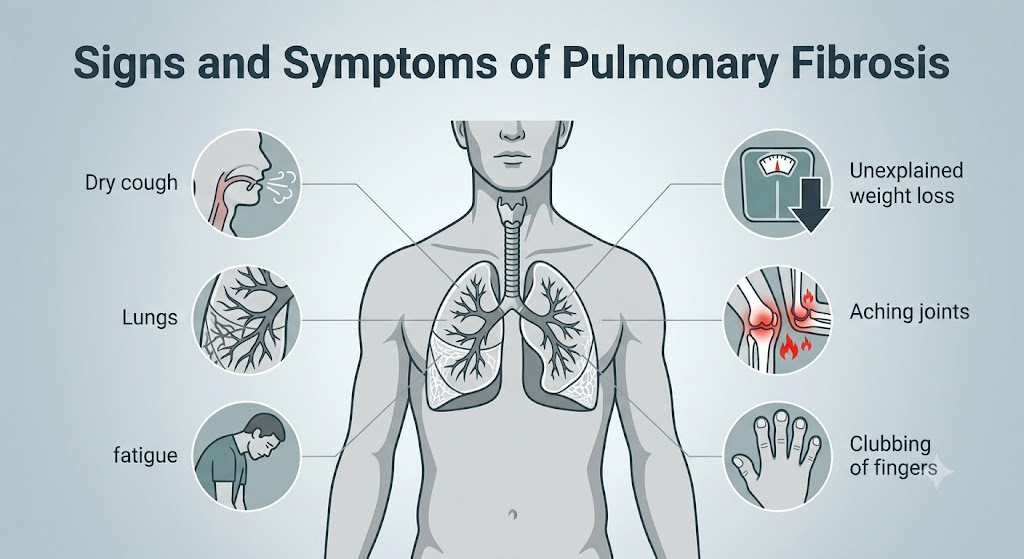
One of the challenges of pulmonary fibrosis is that it does not often make itself known. It tends to progress gradually and the initial symptoms may be attributed to getting older, not being very fit or having a lingering cough from a cold.
The following are the most common symptoms:
- Dry, persistent cough: It often doesn’t expel anything out of the way, and doesn’t go away after a week or two, but it lingers for months.
- Gradually increasing breathlessness: You may become aware of it at first only when going for a brisk walk or the stairs. As time goes on, even dressing up or walking across a room can make it hard to breathe.
- Tiredness: The lungs may be unable to transport oxygen around the body and the whole body suffers, which means tiredness is always there.
- Losing weight without meaning to: As the disease progresses, there may be a decrease in appetite that can lead to a silent weight loss.
- Muscle and joint aches: These tend to occur when the fibrosis is associated with an autoimmune disease.
- Fingers and toes start to change: tips of fingers and toes may start to widen and the nails become curved, a gentle warning that oxygen has been diminished for a while.
Given its slow onset, many people aren’t checked until the condition has reached a moderate stage. This is the true significance of early attention. Because the early signs can easily be mistaken for other lung diseases, it helps to know what sets pulmonary fibrosis apart. A persistent cough, or increasing difficulty breathing, is always worth investigating rather than waiting and hoping it will go away.
Book a consultation today with one of the leading pulmonologists in Noida for a proper evaluation.
Treatment Options for Pulmonary Fibrosis
There’s no treatment that can undo scarring once it has formed, but that’s far from the end of the story. With the right care, the disease can be slowed, everyday symptoms can be eased, and people can stay active and comfortable for much longer.
Here’s a look at how it’s usually managed:
Treatment | What It Does | Why It Matters |
Antifibrotic medicines | Slow down the scarring | Help hold on to lung function for longer, especially in idiopathic cases |
Oxygen therapy | Boosts blood oxygen when levels dip | Eases breathlessness and takes strain off the heart |
Pulmonary rehabilitation | Blends exercise, breathing techniques, and education | Builds stamina and makes daily life easier |
Treating the cause | Manages autoimmune disease or stops exposure | Can slow further damage when a trigger is known |
Vaccinations | Guard against flu and pneumonia | Prevent infections that could make things much worse |
Lung transplant | An option in select, advanced cases | A long-term route when other treatments no longer help |
Medical care is only part of it, though. The little everyday choices carry real weight too. Stopping smoking for good, keeping as active as the body will allow, eating well to protect weight and muscle, and turning up for regular check-ups all make a genuine difference.
Book a consultation today with one of the leading pulmonologists in Noida for expert, long-term care.
When Should You Consult a Doctor?
Some symptoms just shouldn’t wait until your next appointment. With pulmonary fibrosis, spotting the warning signs early can be the difference between something that’s manageable and a real emergency.
Reach out for medical help straight away if you notice:
- Sudden breathlessness, or struggling to breathe even when you’re sitting still.
- A bluish tinge to your lips, face, or fingertips, which usually means oxygen is running low.
- Chest pain or tightness, especially if it’s something you haven’t felt before.
- A cough that changes, bringing up blood or turning up with a fever and thicker mucus.
- Losing weight quickly, or swelling in your ankles and legs.
- Feeling dizzy or confused, or a racing heart, all of which can point to low oxygen.
When symptoms need a closer look, a few tests usually help make sense of what’s going on, like a high-resolution CT scan, lung function testing, and sometimes a bronchoscopy. Once there’s a clear
Frequently Asked Questions
Is pulmonary fibrosis obstructive or restrictive?
It’s restrictive. The scarring stiffens the lungs, so they can’t expand fully and hold less air. That’s the opposite of COPD, where narrowed airways make it hard to push air out.
Can pulmonary fibrosis be cured?
The scarring can’t be undone, but it can be managed well. Antifibrotic medicines, oxygen therapy, and pulmonary rehab all help slow it down and make breathing easier.
How is pulmonary fibrosis diagnosed?
Usually a few tests together: a high-resolution CT scan, lung function tests, and sometimes a lung biopsy or bronchoscopy. These confirm the pattern and point to the cause.
Is pulmonary fibrosis life-threatening?
It can be if left untreated, but the outlook varies from person to person. Catching it early and sticking with treatment makes a real difference.
Does pulmonary fibrosis always get worse?
It tends to progress over time, but how fast varies a lot. With the right care and a few lifestyle changes, many people stay steady and active for a good while.