
A lung nodule found on CT scan is managed by size, density, and risk profile. Nodules under 6mm in low-risk patients need only a 12-month repeat scan. Solid nodules above 8mm, ground-glass nodules with a solid component, or any spiculated edges move to PET-CT, bronchoscopy, or biopsy. Roughly 95% are benign but that figure shifts quickly in smokers over 50 with a family history.
According to Dr. Manu Madan, a leading pulmonologist in Noida, “The mistake isn’t finding a nodule it’s either over-investigating a 4mm calcified granuloma in a 35-year-old or under-investigating a 9mm spiculated nodule in a 60-year-old smoker.”
Unsure what your CT report means or what to do next?
How Does Nodule Size and Type Decide the Follow-Up Plan?
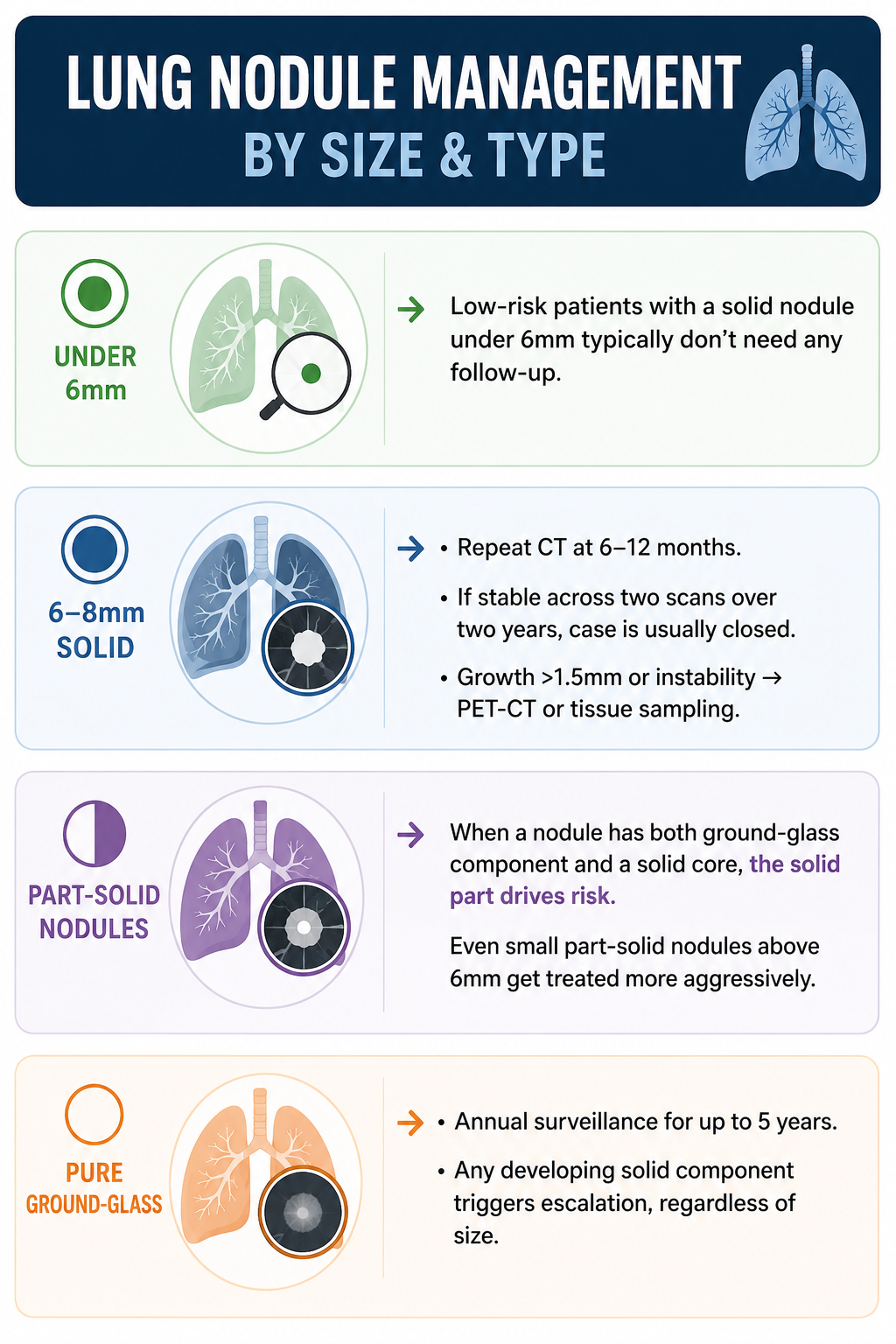
Fleischner Society guidelines apply only to incidentally detected nodules in patients over 35 with no prior lung cancer history; different protocols govern screening programs and post-treatment surveillance, where bronchoscopy often becomes the next diagnostic step.
When Does a Lung Nodule Actually Need a Biopsy or Surgery?
Not every nodule that warrants investigation ends up needing tissue the decision depends on probability calculations, not anxiety levels.
PET-CT first: For nodules above 8mm where malignancy can’t be ruled out by morphology alone, a PET-CT scan is usually ordered before any invasive procedure because a metabolically inactive nodule one that doesn’t light up on PET rarely turns out to be active cancer, which saves patients from unnecessary bronchoscopy.
Bronchoscopy reach: Centrally located nodules accessible via the airway are biopsied through bronchoscopy, and newer navigational bronchoscopy techniques have extended the reach to peripheral nodules that weren’t reachable a decade ago the procedural choice depends on location, not just nodule size.
CT-guided biopsy: Peripheral nodules that sit close to the chest wall or pleura are better reached by CT-guided needle biopsy, which carries a small pneumothorax risk of around 15 to 20% that resolves without intervention in most cases it’s worth knowing upfront rather than being surprised post-procedure.
Surgery directly: When imaging is strongly suspicious and a biopsy result won’t change the decision to operate anyway, thoracic surgeons sometimes proceed directly to video-assisted thoracoscopic surgery this avoids a separate biopsy procedure and allows simultaneous diagnosis and resection in a single admission.
The nodule pathway isn’t linear clinical judgment, patient fitness, and what the patient is willing to accept all factor into which investigation comes next. Early Warning Signs of Interstitial Lung Disease
Why Choose Dr. Manu Madan?
Dr. Manu Madan completed his DM from AIIMS, New Delhi, MD from Vallabhbhai Patel Chest Institute, and MBBS from Maulana Azad Medical College. Senior Consultant and Lead of Respiratory and Sleep Medicine at Medanta Hospital, Noida, he has over 40 peer-reviewed publications and performs advanced procedures including bronchoscopy, EBUS, and thoracoscopy.
Patients referred for nodule evaluation get a specific recommendation grounded in Fleischner criteria and individual risk not a default referral chain. No unnecessary procedures, no missed windows.
Frequently Asked Questions
Does a lung nodule always mean cancer?
No, around 95% of incidentally found lung nodules are benign.
How long does lung nodule surveillance last?
Typically 2 to 5 years depending on nodule type and patient risk profile.
Can a lung nodule disappear on its own?
Yes, inflammatory or infectious nodules often resolve without treatment over months.
Do I need to stop smoking if a nodule is found?
Yes smoking significantly increases the probability that any nodule is malignant.